
No One Has Seen the Bayeux Tapestry Like This in 1,000 Years
Starting September 10, 2026, the Bayeux Tapestry goes on display at the British Museum in London – for the first time in nearly 1,000 years.
It has never been shown in the UK since it was made. Not once. And it won’t be here forever: the exhibition runs until July 11, 2027.
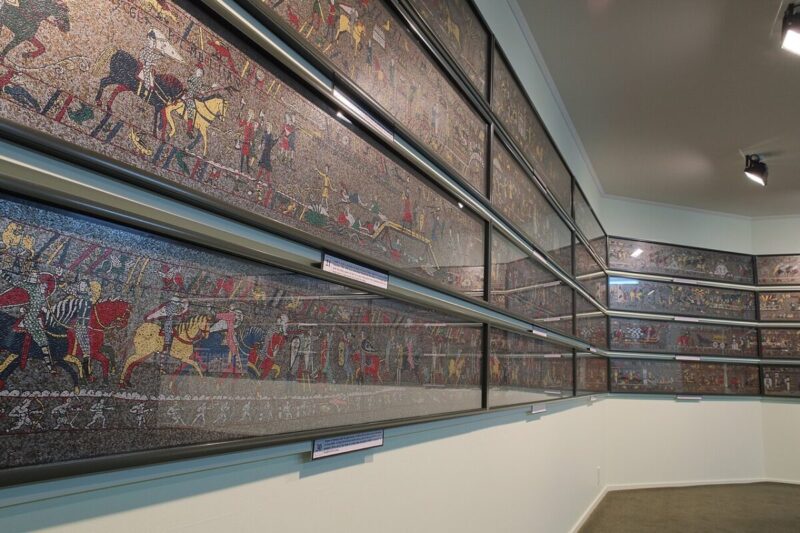
Think of it as the world’s oldest graphic novel. It’s 70 metres long – that’s roughly the length of two full basketball courts laid end to end – and it tells the story of the Norman Conquest of England in 1066.
Through 58 scenes, 626 characters, and 202 horses, it captures everything from political intrigue at the English court to the chaos of the Battle of Hastings.
It’s embroidered in wool thread on linen cloth, and it was made right around the same time as the events it depicts.
Here’s what ties France and England together: it was almost certainly commissioned by a Norman patron and sewn by English embroiderers. It belongs to both countries – that tension is part of what makes it so fascinating.
A Display Unlike Anything Before
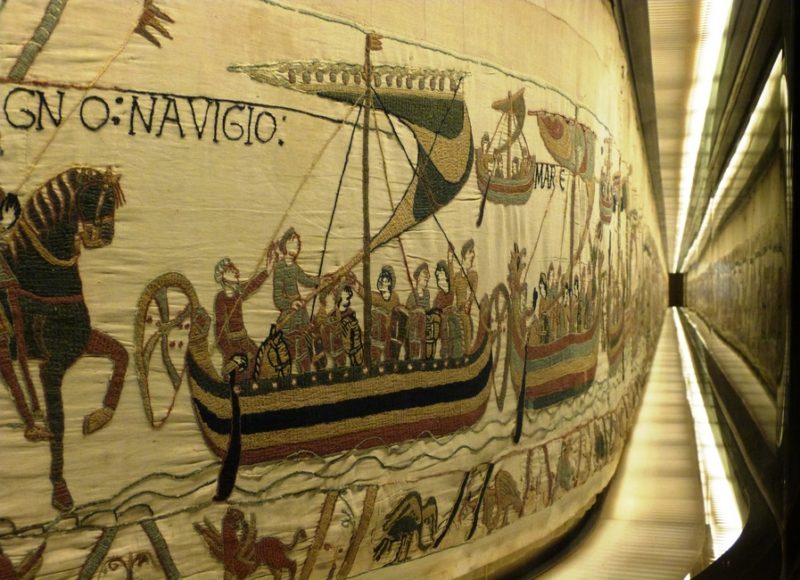
For decades, visitors to the Bayeux Tapestry Museum in Normandy saw the tapestry displayed vertically, curved around a specially built case. That’s how it has always been shown.
The British Museum is doing something completely different.
The full 70 metres will be laid flat in one continuous, specially designed display case – so you can see the entire thing in an unbroken line for the first time. Digital elements will also be integrated to help bring the medieval scenes to life.
It won’t be a passive experience. You walk the full length of it. That’s a lot of history to take in over 40 minutes.
The tapestry won’t be alone. The British Museum is surrounding it with loans that most visitors will never have seen alongside the tapestry before.
The Junius II manuscript, produced around AD 1000 in Canterbury and held by the Bodleian Libraries at Oxford, is thought to have directly influenced the tapestry’s depictions of clothing, ships, and everyday objects.
The Chew Valley Hoard – a collection of silver pennies from the reigns of both Harold II and William I – will be on loan from the South West Heritage Trust.
Those coins were buried shortly after the Norman Conquest, likely during unrest in the southwest of England as William consolidated power.
There’s also a charter written by William I to the citizens of London in 1067, composed in Old English. It promises the new king would uphold the laws of Edward the Confessor.
A political document, essentially – and a remarkable one to see in person.
And in exchange for all of this, British treasures travel the other direction. Sutton Hoo artifacts and the Lewis chess pieces are heading to museums in Normandy. A genuine cultural exchange between two countries.
Getting Tickets – Don’t Wait
Public tickets go on sale July 1, 2026, and the first batch covers visits between September and December 2026 only. Expect them to move fast.
Prices run from £25 to £33 depending on day and time – that’s roughly $32 to $42 for American visitors at current exchange rates. Under-16s get in free with an adult.
The British Museum drew 6.5 million visitors in 2024. They’re projecting 7.5 million for 2026 driven almost entirely by this exhibition.
George Osborne, Chair of Trustees, called it “without doubt the biggest year in the Museum’s history.”
When You Go
Plan around September or October if fall travel is on your radar. London’s shoulder season pricing tends to be gentler, and the crowds, while significant, will be more manageable than peak summer.
The Bayeux Tapestry Museum in Normandy, where the tapestry normally lives, is closed for major renovation until at least October 2027. When the tapestry returns, it goes directly into a brand-new museum built around it.
This window – September 2026 to July 2027 – is the only time in your lifetime you are likely to see it outside of France.