
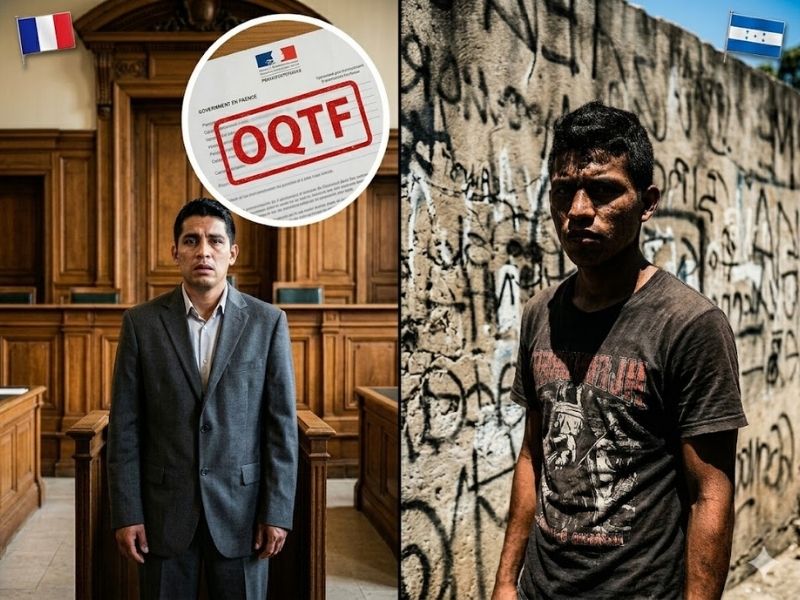
France Deported a Man Who Warned He Would Be Killed
Ruben Torres had one clear message for French immigration authorities: if you send me back, I will die.
He said it to judges. He said it to his lawyer. He said it to anyone who would listen.
They did not believe him.
A threat that started 15 years ago
Ruben was 37 years old and had been living in Bordeaux since 2024, when he arrived to join his brother, who already held French citizenship through their French father.
The story behind his flight from Honduras begins more than a decade before he ever set foot in France.
Fifteen years ago, Ruben’s brother reported a gang member for murder. The man went to prison. Then he escaped.
During one of those escapes, he found Ruben. He pressed a gun to his face and told him: if I ever see you again, I will kill you.
Coming to France and running out of road
Ruben filed for asylum in France in 2024. His request was rejected in June 2025.
He appealed to the CNDA, France’s national asylum court. The court confirmed the rejection.
On September 18, 2025, the Gironde prefecture issued him an OQTF – an obligation to leave French territory.
His lawyer, Pierre-Antoine Cazau, tried to contest the order through a formal appeal. The paperwork was still moving through channels when Ruben ran out of time.
Life under an OQTF
The months that followed the deportation order were a kind of slow suffocation.
Ruben became afraid to leave his apartment. He feared being picked up by police and placed in a detention center while his case was pending.
He couldn’t find work either. No employer would hire someone with an outstanding OQTF.
“He was like a lion in a cage,” his lawyer said.
During that period, Ruben enrolled in French classes at ASTI Bordeaux, a local association that supports refugees. He attended for four months. He had just passed a practice exam to certify his language level.
When he stopped showing up, they assumed something was wrong. They were right.
The impossible math
France processed 145,211 asylum requests in 2025. Of those, 78,782 were granted – roughly one in two.
For the other half, an OQTF follows almost automatically. From that moment, a person has 30 days to contest the order in court.
If they can’t find a judge willing to overturn it, they face a choice: leave voluntarily or risk detention and forced expulsion.
Ruben’s problem was a specific one: proving gang threats is extraordinarily difficult. Gangs don’t send written notices. There are rarely witnesses willing to testify.
The threat against him was real, his family says – but “real” and “provable” are not the same thing in an asylum hearing.
The last flight
On February 28, 2026, Ruben Torres boarded a plane back to Honduras.
He hadn’t wanted to go. But despair, his lawyer says, had overtaken fear. Living without papers, without income, without any path forward had become unbearable.
He accepted an assisted return grant from the French government – money designed to help people rebuild their lives in their home countries.
His plan was to wait one year, then apply again from Honduras for a French visa and file a new asylum request.
He didn’t make it one year. He didn’t make it two weeks.
Found at the bottom of a ravine
On March 10, 2026 – ten days after landing in Honduras – Ruben Torres was found dead at the bottom of a ravine.
His mother found the body.
His family says every indication points to the gang that had threatened him years before. A formal investigation is ongoing.
Back in Bordeaux, Serge Milhé, president of ASTI, described the news in three words: “C’est du gâchis.” What a waste.
His lawyer put it differently: “France sent him back to the slaughterhouse.“
Ruben’s brother and other family members decided to make his story public. They want people to understand what an OQTF actually means – not as a legal term, not as a policy number, but as a life cut short.
“OQTFs aren’t just words,” his lawyer said. “They are people who live with these decisions.”