
The Heat Warning No One Sends You Before Your Europe Trip
Europe in the summer is one of life’s great pleasures. It’s also, increasingly, a sweaty one.
Temperatures have been breaking records across the continent for years. In summer 2025, Portugal and Spain shattered national June records, with temperatures pushing past 46°C (115°F).
Scientists estimate the heat killed more than 16,500 people across Europe that summer, with around 68% of those deaths tied directly to climate change.
And 2025 was just Europe’s second-worst heatwave on record.
The cities you love most – Paris, Rome, Madrid – are at the center of all this.
The AC Problem Americans Don’t Expect
About 90% of homes in the United States have air conditioning. In Europe, that number is around 20%. In France, it’s roughly 25%.
Many hotels, apartments, and restaurants simply don’t have it.
This catches American travelers off guard every single summer.
And the heat doesn’t behave the way you’d expect, either. In big cities like Paris and Rome, temperatures are actually higher around 5-6pm than they are at noon.
All that concrete absorbs heat throughout the day and releases it into the evening. So just when you’re thinking about heading out for dinner, the city is at its hottest.
Book the Right Room
If your hotel or Airbnb doesn’t have AC, the room’s location matters enormously. Top-floor apartments absorb the most heat. So do south and west-facing rooms.
Ask specifically which floor and which direction the windows face before you book. A ground-floor room facing a courtyard will be far cooler than a top-floor room with southern exposure – even in the same building.
If there’s no AC listed, ask whether the property has fans. If they won’t provide one, a portable fan runs about 25 euros and is worth every cent.
Paris: Free Cold Water Is Everywhere
Paris has more than 700 free drinking water points spread across the city. The most famous are the Wallace Fountains – cast iron sculptures designed by English philanthropist Richard Wallace in the 19th century.
You’ll find them in parks, along boulevards, and near major landmarks.
Some of the newer dispensers even offer free sparkling water.
When temperatures spike, the Louvre, the Musée d’Orsay, and the Musée Picasso are all air-conditioned. A long afternoon inside any one of them is both culturally and physically rewarding.
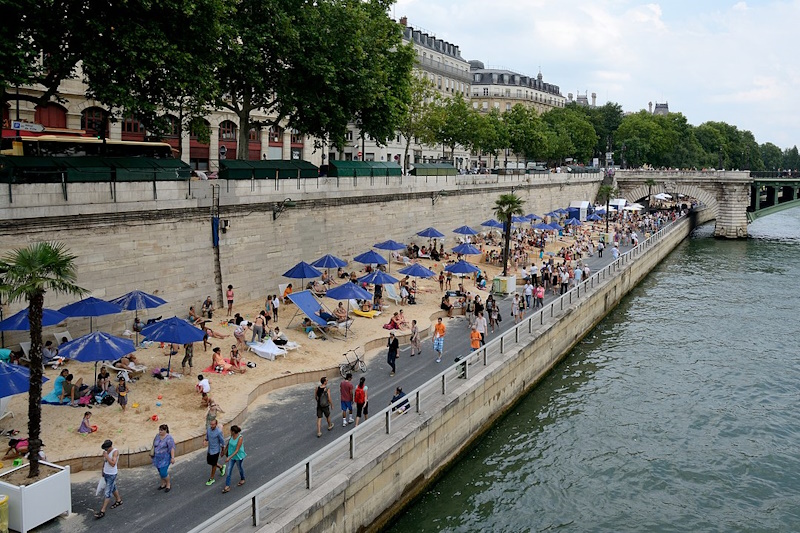
Paris also sets up artificial beaches along the Seine every summer (Paris Plages) where you can cool off without leaving the city.
Rome: Drink From the Nasoni
Rome has over 2,500 public drinking fountains called nasoni – Italian for “big noses,” named after their curved metal spouts. They’ve been running continuously since 1874, and they never stop.
You’ll find them near the Colosseum, around the Trevi Fountain, at the Spanish Step near the Pantheon. Everywhere. The water is cold, clean, and free.
Refill your bottle at a nasone instead of buying water. It adds up fast when you’re out all day in 35°C heat.
Madrid: Rethink Your Hours
Madrid locals know something visitors don’t: the city doesn’t actually slow down in the heat, it just shifts its schedule.
Skip the midday hours. The Spanish tradition of a long lunch and a rest in the early afternoon exists for a reason. Save your major sightseeing for before 11am or after 7pm.
In the evenings, locals head to the stretch along Bailen Street near Templo de Debod, where a breeze tends to move through.
The Museo del Prado and the Museo Reina Sofia are both air-conditioned and open into the evening on select nights.
One Packing Item Not To Forget
A small, personal misting fan. You’ll see Europeans carrying them. You’ll want one.
A UV-protection umbrella used as a parasol is also worth adding to your bag.
Bare arms and legs might feel cooler, but they increase sunburn risk – and many churches and monuments across Italy and Spain require covered shoulders and knees to enter.
Time of Day Is Everything
Health organizations recommend avoiding peak sun between 11am and 3pm – but remember, in Paris and Rome, the hottest moment of the day is actually late afternoon, around 5 or 6pm. Plan accordingly.
Morning sightseeing, a cool museum or shaded café at midday, and an early dinner before the peak evening heat. Europe in summer rewards the people who adapt to it.