

Where Inflation Hurts Most in Europe Right Now – How Does France Fare?
If you’ve been following prices in Europe lately, you’ve probably noticed things feel different depending on where you are.
A coffee in Bucharest versus a coffee in Zurich. A grocery run in Sofia versus one in Paris. The gap is real – the latest data makes it very clear.
Using 2026 figures from Eurostat and the UK Parliament, covering the 12 months up to April 2026, here’s how 36 European countries stack up on inflation right now.
The Countries Getting Hit Hardest
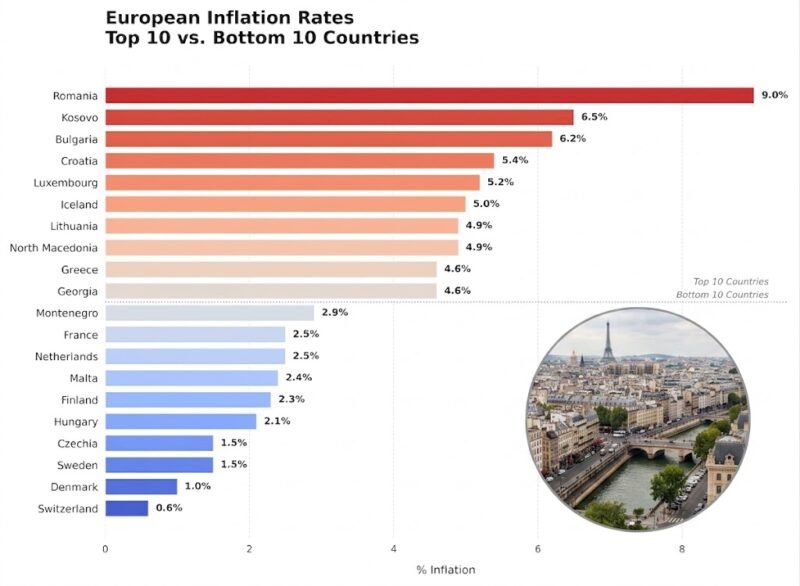
Romania is in a league of its own. At 9.0% annual inflation, it’s the worst in Europe by a significant margin.
To put that in perspective: that’s roughly where the U.S. was at the peak of its inflation crisis in 2022. For Romanians, that’s what they’re living through today.
Kosovo comes in second at 6.5%, followed by Bulgaria at 6.2%. Croatia is at 5.4%, Luxembourg at 5.2%, and Iceland at 5.0%.
Notice a pattern? Most of the highest-inflation countries are in Southeastern Europe.
The exceptions, Luxembourg and Iceland, have their own structural reasons, including tight labor markets and high energy import dependency.
The Middle of the Pack
Lithuania and North Macedonia are both at 4.9%. Greece and Georgia are tied at 4.6%.
Belgium (4.3%), Slovakia (4.0%), and Ireland (3.6%) round out the top tier before things start cooling off.
Germany sits at 2.9%, still above the European Central Bank’s 2% target. Spain is at 3.5%. The UK is at 3.3%.
The U.S., for comparison, was running at around 2.4% in early 2026.
Where France Lands
France comes in at 2.5% – well below most of its neighbors and below the U.S. rate.
For most of 2025 and into early 2026, France was one of the lowest in all of Europe, sometimes second only to Switzerland.
A government-mandated 15% cut in electricity prices in February 2025 held energy costs down for most of the year.
That buffer is fading. France hit 2.2% in April 2026, its highest since mid-2024, as petroleum prices surged following the outbreak of the Iran war.
Still, at 2.5%, France remains one of the most price-stable major economies on the continent.
The Countries Almost Beating Inflation
Switzerland is at the very bottom: 0.6%. That’s not just the lowest in Europe, it’s among the lowest in the world.
Denmark follows at 1.0%, then Czechia and Sweden both at 1.5%.
Here’s the interesting detail: those four countries, Switzerland, Denmark, Czechia, Sweden, are the only ones fully within the ECB’s 2% inflation target. And none of them use the euro.
Driving Prices Up Again
After a period of relative calm, European inflation started ticking back up in early 2026.
The euro area hit 3.0% in April 2026, up from 1.9% in February. The main driver: energy, which surged nearly 11% year-over-year.
The Iran war sent petroleum prices sharply higher across the continent. Countries that import more oil and have fewer domestic energy alternatives, particularly in Eastern Europe, are feeling it most.
Traveling to France?
France is not cheap, it never was. But compared to the wider European picture, it’s holding up well.
Your euros go further in France than in most of its neighbors. And compared to what Americans experienced domestically in 2022, France’s current inflation environment is mild.
Romania’s 9.0% means locals there are watching prices climb every month. In France, that pressure exists but at a fraction of the intensity.
If you’re weighing a trip or thinking about a longer stay, the price stability is one more point in France’s favor – even if that café au lait still costs what it costs.