
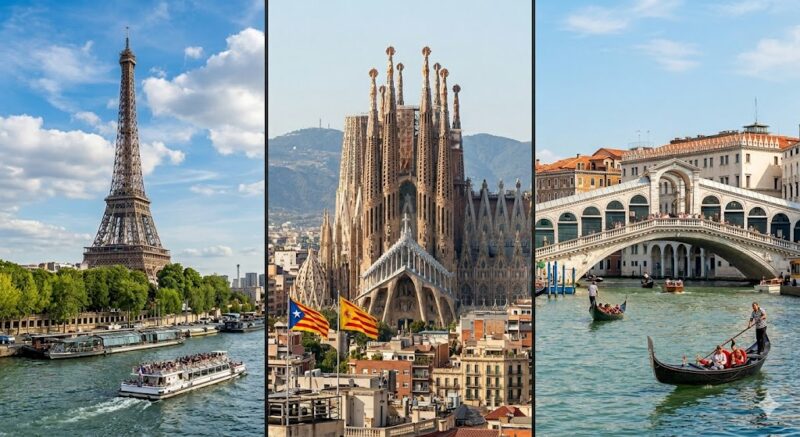
France vs. Spain vs. Italy: Which One Wins for the Way You Travel?
Every year, the same debate comes back. France says it’s the world’s favorite. Spain says it makes more money. Italy says it keeps people longer. They’re all kind of right – and that’s what makes this rivalry so interesting.
Here’s what the actual 2024 numbers say, and what they mean if you’re trying to decide where to go next.
France: The Most Visited Country on Earth
France hit 102 million international visitors in 2024. That’s a record, and it’s a genuinely remarkable one – no country in history has ever crossed that mark in a single year.
To put it in perspective, France welcomed more tourists than the entire population of Germany – twice over.
A lot of that was driven by the Paris Olympics, which brought a surge of first-time visitors and curious travelers who had been on the fence.
American overnight stays in France specifically climbed 5% that year. The French government openly called Americans “a key clientele” with strong purchasing power.
So why isn’t everyone celebrating in Paris?
The Money Problem France Can’t Ignore
Here’s the uncomfortable truth for France: it gets the most visitors but earns far less per tourist than Spain.
In 2024, France’s 102 million visitors generated €71 billion ($77 billion) in tourism revenue. Spain’s 93.8 million visitors, nearly 10 million fewer, generated $106.5 billion.
That gap isn’t a rounding error, it’s a structural problem.
France’s own tourism minister, Nathalie Delattre, said publicly: “We need to work to increase the average each visitor spends and get our visitors to stay longer.”
The issue is that many people treat France as a transit stop – a few days in Paris, then off to Italy or Spain. Short stays, lower hotel bills, less restaurant spending.
Spain, by contrast, holds people. Sun, beaches, all-inclusive resorts. Tourists arrive and don’t leave until they have to.
Spain: Fewer Tourists, More Money
Spain’s 2024 numbers are astonishing. 93.8 million arrivals. $106.5 billion in revenue. 500 million overnight stays. The most of any country in Europe by a wide margin.
The average tourist to Spain spends significantly more per trip than the average tourist to France.
That combination of volume and duration makes Spain the most economically powerful tourism destination in Europe, even if it doesn’t top the arrivals chart.
Spain does have a problem of its own, though. Residents of Barcelona and Mallorca have been organizing anti-tourism protests, with locals saying they’ve been priced out of their own neighborhoods by short-term rentals and surging costs tied to mass tourism.
The country that wins the tourism revenue game is also the country where locals are most fed up with tourists.
Italy: The Dark Horse
Italy often gets overlooked in this debate, but it probably shouldn’t be.
57.8 million international arrivals in 2024. 458.4 million overnight stays, which actually edged out France’s 450 million, putting Italy in second place behind Spain for nights spent.
Foreign visitors left €54.2 billion behind in Italy, up nearly 5% from the previous year. Rome, Venice, Florence, and the Amalfi Coast continue to rank among the most-requested bucket list destinations for American travelers.
Italy’s tourist numbers grew 6.8% on the foreign side in 2024, beating the EU average. The country is not losing ground. It’s quietly gaining it.
So Who Actually Wins?
Depends entirely on what you’re measuring.
France wins on raw arrivals: 102 million is a number nobody else is close to. But its own government admits it needs to work harder to keep people longer and get them spending more.
Spain wins on money and nights spent. It earns more, holds visitors longer, and is on track to potentially overtake France on arrivals within the next few years.
Italy wins on per-visit quality. Travelers who go to Italy tend to stay, explore, and spend – and the country is growing its international numbers faster than either rival.
The Spanish tourism board reported that 2025 was another record year, with Spain crossing 96.8 million visitors and generating €134.7 billion in spending – an average of €1,514 per tourist.
France’s target is €100 billion in tourism revenue by 2030. Spain already crossed that mark years ago.