
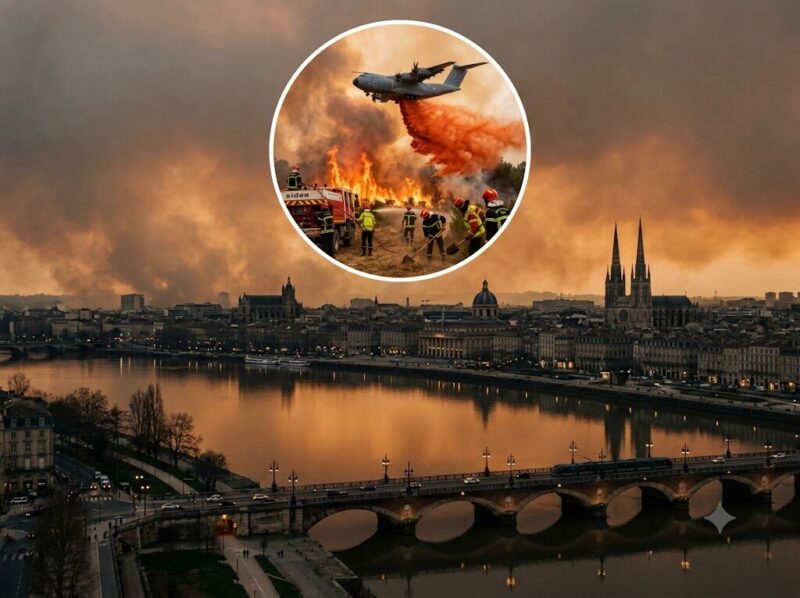
France is On Fire. Should You Still Go?
France is having its worst wildfire season on record, and it’s only July.
More than 250,000 people have been displaced across France, and 115,000 hectares have already burned this year alone.
The country’s interior minister called that number “far more than anything we have seen in the past.”
So if you have a trip booked, here’s what you need to know right now.
Where the Fires Are
The worst of it is concentrated in southwest France. Gironde and the neighboring Landes department have been the hardest hit, with areas like Lège-Cap-Ferret, Le Porge, Saumos, and Lacanau taking the brunt of the damage.
Gironde alone has seen more than 220,000 people evacuated. A 60-kilometer stretch of the A63 motorway between Bordeaux and the Spanish border has been closed.
The fires are not only in the south. A wildfire tore through the Fontainebleau forest, roughly 60 kilometers from Paris, in mid-July.
The blaze scorched around 2,000 hectares and closed a major motorway out of Paris for several days. TGV departures from the capital were also suspended.
Is Paris Safe to Visit?
Paris itself is not under any threat right now. The Fontainebleau fire was serious but is not ongoing in the city.
If you’re heading to Paris or northern France, there is no evacuation or travel warning in place for those areas.
You may encounter some travel disruptions if fires flare near rail or road networks, but that is not the current situation.
What About Bordeaux?
Bordeaux city itself is not directly under threat, according to its mayor.
But it is surrounded by fire-affected areas, shrouded in smoke, and currently hosting thousands of evacuees at the Parc des Expositions exhibition center.
Bordeaux Airport is open. Flights are running as normal, with priority being given to departing aircraft.
Bus and tram services to the airport are also running, though trams are now operating non-stop between Mérignac Soleil and the terminal, skipping the intermediate stop.
One catch: hotels near the airport have been evacuated by order of the local prefect. If you’re arriving late or leaving early, book accommodation outside the evacuation zone.
What the UK Government Says
As of today, the UK’s Foreign, Commonwealth and Development Office has not advised against travel to France. But its guidance has been updated to reflect the southwest fires.
The FCDO confirms that French authorities have evacuated campsites, tourist accommodation, and residential areas in Gironde and Landes.
It also warns that road access to affected areas may be restricted at short notice, and that further evacuations remain possible.
The U.S. State Department has France at a standing Level 2 advisory, meaning “exercise increased caution,” but has issued no separate wildfire warning for the country.
Americans traveling to the southwest should monitor the State Department’s France page at travel.state.gov for any updates.
You can also enroll in STEP (the Smart Traveler Enrollment Program) to receive alerts from the U.S. Embassy in Paris directly to your inbox
If you’re in or near the affected areas, the emergency number is 112. There is also a dedicated public information line for the wildfires, open 9am to 5pm: +33 (0)9 70 80 90 40. Press 1 for Gironde, press 2 for Landes.
If You Get Caught Near a Fire
France has a solid system for tracking wildfire risk. The Météo France forest fire map publishes daily risk levels by département, ranging from green (low risk) to red (very high).
The government-backed Feux de Forêt app gives real-time updates on active fires and lets you set notifications for your area.
France also uses FR-Alert, an emergency text system sent to all phones in a danger zone, including foreign ones. It rings loudly even if your phone is on silent.
If you are told to evacuate, leave. Do not stop to pack. Fires in pine forest move fast, and wind direction can shift within minutes.
The most recent wildfire death in France, in 2025, was an elderly woman who refused to leave.
Your Rights If You Cancel
If your accommodation has been evacuated or forced to close, you should be entitled to alternative arrangements or a full refund from your provider.
Whether you’re entitled to a refund depends mostly on whether your government issues a formal warning against travel to your destination.
Right now, neither the UK nor the US has done that for France.
For UK travelers, refund rights on package holidays hinge on a formal FCDO “do not travel” advisory. That hasn’t been issued.
For Americans, travel insurance is your main lever. Most US policies don’t require a State Department warning to pay out on natural disaster disruptions, but the exact wording varies by policy.
Check what yours says about “natural disasters” and “civil emergencies” before assuming you’re covered.
The Rest of France
Paris, Lyon, Brittany, Alsace, the Loire Valley, Normandy: none of these regions are under wildfire threat or evacuation orders right now.
Temperatures across France are forecast to rise again this week, which could worsen conditions in the southwest.
The situation in Gironde is still being described by officials as unpredictable.
Check the FCDO travel advice page and your airline’s status page close to your departure date. Conditions have been changing by the hour.