
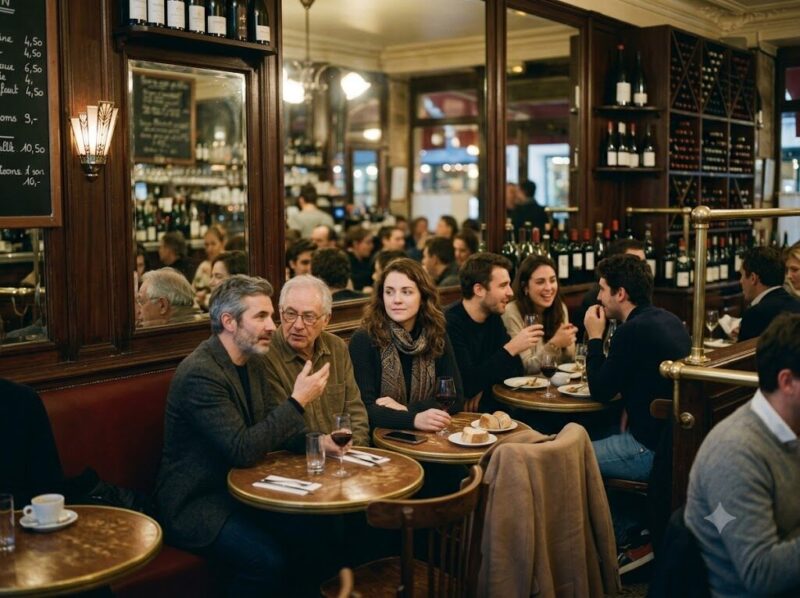
Why French People Don’t Do Small Talk – And What Americans Get Wrong About It
If you’ve ever walked out of a Paris café feeling vaguely snubbed, you’re not alone.
The waiter didn’t smile. Nobody asked how your day was going. The checkout cashier at Monoprix bagged your groceries in silence and moved on.
You probably thought: were they rude, or did I do something wrong?
Neither. You ran into one of the most misunderstood cultural gaps in all of travel.
The Silence Isn’t Coldness
French people don’t fill silence with small talk. This isn’t a personality quirk or a Paris thing. It’s a deeply ingrained cultural norm that applies from Lyon to Marseille to a village in Normandy.
In French culture, silence between strangers is completely comfortable. It signals respect, not disinterest.
You’re not expected to perform friendliness to put the other person at ease. The interaction can simply be what it is.
Americans, by contrast, are raised to treat silence as something that needs fixing. You ask the person behind the counter how their day is going. You say “have a great one” on your way out. You make small talk in line.
In France, that kind of reflexive cheerfulness reads as hollow, even a little strange.
The Bonjour Rule
French people are not indifferent to courtesy. They are more rule-bound about certain greetings than most Americans realize.
French people are not indifferent to courtesy. Greetings are taken seriously here, just not the ones Americans reach for.
Walk into a shop without saying “Bonjour” and you’ve already made a bad impression, before you’ve asked for anything.
Say “Bonjour, madame” or “Bonjour, monsieur” when you walk in. Say “Au revoir” when you leave. Those two phrases will transform a huge percentage of your interactions. The French respond to them because they’re the expected opening move.
You don’t need to fill the space after that.
Peaches and Coconuts
There’s a useful framework that researchers use to explain this gap: Americans are peaches, the French are coconuts.
Peaches are soft on the outside. Warm, open, chatty with strangers. Easy to get to know superficially. But at a certain point you hit the pit, and things stop. Americans have a lot of these surface-level connections.
Coconuts are hard on the outside. Reserved, formal, unlikely to share much with someone they just met. But get past the shell and the relationship is genuinely close. French friendships tend to be fewer, deeper, and longer-lasting.
Neither is better. But when a coconut meets a peach, the peach seems fake, and the coconut seems cold. That’s the entire pattern of Americans-in-France in one sentence.
What the Cashier Is Thinking
When an American tourist says “Have a great day!” at a register in Paris, the cashier is not charmed by the warmth. They’re uncertain what to make of it.
The sentiment feels performed rather than real, and the French put a high premium on sincerity.
The famous “French rudeness” complaint is almost always this misreading playing out in both directions.
The American thinks the French person is being cold. The French person thinks the American is being performative.They’re just running different social software.
What to Do With This
You don’t need to suppress your personality. You just need to adjust two things.
Stop trying to fill silence. Let a pause sit without jumping in. It reads as confidence in France, not awkwardness.
And drop the automatic pleasantries. The French version of politeness is formal and exact: the right greeting at the right moment, not a constant background hum of cheerfulness.
When a French person warms up to you, and they do, it feels earned. That’s not an accident. It’s the coconut cracking open, and it means something.