
Iran Is Running a Terror Network Inside Europe
Something shifted in Europe’s security picture over the past year, and most travelers haven’t noticed.
Iran isn’t sending trained agents in trench coats anymore.
It’s recruiting biker gang members. Human traffickers. Ordinary criminals who have no idea they’re working for a foreign government.
That’s the picture coming out of Germany right now, and it has direct implications for anyone planning a trip to Paris, Munich, or any major European city.
What German Intelligence Found
Germany’s Federal Office for the Protection of the Constitution, the country’s main domestic intelligence agency, issued a stark warning in late April 2026.
The threat from Iran-linked extremist groups inside Europe is rising. And it’s getting more dangerous.
One group specifically named, Harakat Ashab al-Yamin al-Islamiya, announced it would no longer limit itself to “simple” attacks. It’s now threatening to use more dangerous means.
The Number That Should Alarm You
Before the Iran war even started, European intelligence services had already identified around 50 suspected Iran-connected plots inside Germany alone.
That’s 50 specific cases being tracked, investigated, and – hopefully – disrupted.
The New York Times reported in May 2026 that German intelligence officials privately warned the situation is far more serious than what the government has been telling the public.
State-level agencies had been pushing political leaders to issue stronger warnings for months.
Who Iran Is Targeting
The primary targets are Jewish institutions – synagogues, schools, community centers.
German officials told the Times that two Jewish institutions in Germany are believed to be the subject of current active plots from Iran’s leadership.
In April 2026, assailants smashed the windows of an Israeli restaurant in Munich and threw explosive devices inside. German investigators are examining whether Iranian proxies were involved.
Iranian intelligence has also been documented threatening and physically assaulting anti-government Iranian protesters at a large demonstration in Munich earlier this year.
Harder to Stop Than Before
The criminal proxy model is the part that concerns French intelligence most.
Iran outsources operations to people with no ideological connection to the regime, someone recruited through a criminal network, maybe paid a flat fee, given a target and told to act.
The surveillance methods that worked in the past become far less effective.
France learned this the hard way. A 2023 plot targeting Israeli interests in the south of France involved organized crime figures who almost certainly had no idea they were acting on behalf of Tehran.
Since 2015, French intelligence has documented Iran systematically preferring criminal proxies over ideological operatives, a direct response to European agencies getting better at detecting traditional spy networks.
The Legal Escalation That Changed Everything
On February 19, 2026, the EU unanimously designated Iran’s Revolutionary Guard Corps – the IRGC – as a terrorist organization.
That was a historic move, placing the IRGC alongside Al-Qaeda and ISIS on Europe’s terrorist list.
Tehran responded by designating the German military (the Bundeswehr) and other EU armed forces as “terrorist groups” themselves.
Germany’s military intelligence agency has been on heightened alert since. A spokesperson said “a significant risk from cyber-espionage must also be assumed” alongside physical threats.
What 14 Countries Agreed On
In July 2025, 14 governments, including France, the United States, the United Kingdom, Germany, the Netherlands, Sweden, and Canada, issued a rare joint statement.
They condemned Iranian intelligence services for plotting to kill, kidnap, and harass individuals across Europe and North America, and for their deepening collaboration with international criminal organizations.
“We are united in our opposition to the attempts of Iranian intelligence services to kill, kidnap and harass people in Europe and North America,” the statement read.
The networks described in that statement are, by all accounts, still operational.
Traveling to Europe
Paris and major French cities remain open and safe for tourists. You are not a target. But the security environment is more complicated.
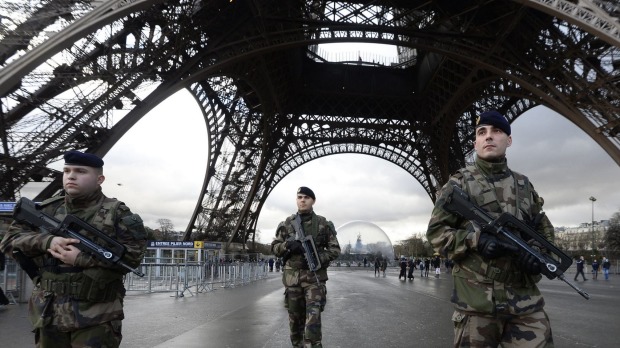
French Interior Minister Laurent Nunez ordered reinforced security around diplomatic sites and sensitive locations when the Iran conflict escalated.
If you’re visiting Jewish neighborhoods, major landmarks, or areas near embassies, expect a more visible security presence than in previous years.
British authorities say they have disrupted more than 20 Iran-linked operations since 2022. French and German agencies have been running parallel operations.
The question that European security services are wrestling with right now: when Iran pays someone through three layers of criminal intermediaries to carry out an attack, how do you see it coming?