
Musée des Arts Forains: Worth a Visit?
The Musée des Arts Forains is a rare interactive museum located in the 12th arrondissement of Paris that breaks the standard rules of heritage sites.
Instead of viewing artifacts from behind glass, visitors are invited to sit on 100-year-old carousels and play mechanical games from the 19th century.
This private collection is housed within the Pavillons de Bercy, a series of historic wine warehouses built in 1886 by architect Ernest Lheureux.
During that era, Bercy was the largest wine market in the world, and you can still see the original railway tracks in the cobblestone streets where barrels were once transported from the Seine.
Founder Jean Paul Favand spent decades gathering more than 1500 independent works of art and 14 major amusement rides dating from 1850 to 1950.
He established the museum in 1996 with a philosophy of active museology, believing that fairground objects only truly exist when they are in motion.
For travelers used to the static galleries of the Louvre, this site offers a physical connection to the Belle Époque. It serves as a living record of the craftsmanship and engineering that defined European entertainment before the digital age.
The Thematic Rooms
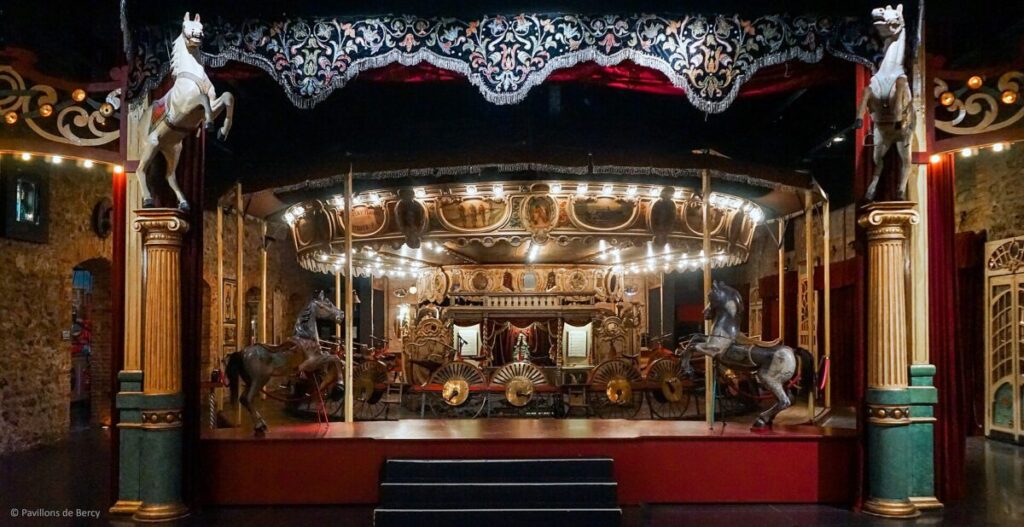
The museum is divided into 4 distinct areas that each celebrate a different aspect of 19th-century imagination.
The Museum of Fairground Arts section is a tribute to the traveling funfairs of the 19th century, with hand-carved wooden horses and traditional booths.
The Theatre of Marvels focuses on illusions and early cinema technology. It uses 12 different projectors to create a video-mapping experience that transforms the walls into underwater scenes or fantastic landscapes, blending modern tech with curiosities like a mechanical unicorn that appears to play the piano.
The Venetian Salons offer a completely different atmosphere inspired by the carnival culture of Italy. This space features a gondola carousel and a set of automated figures that perform operatic arias.
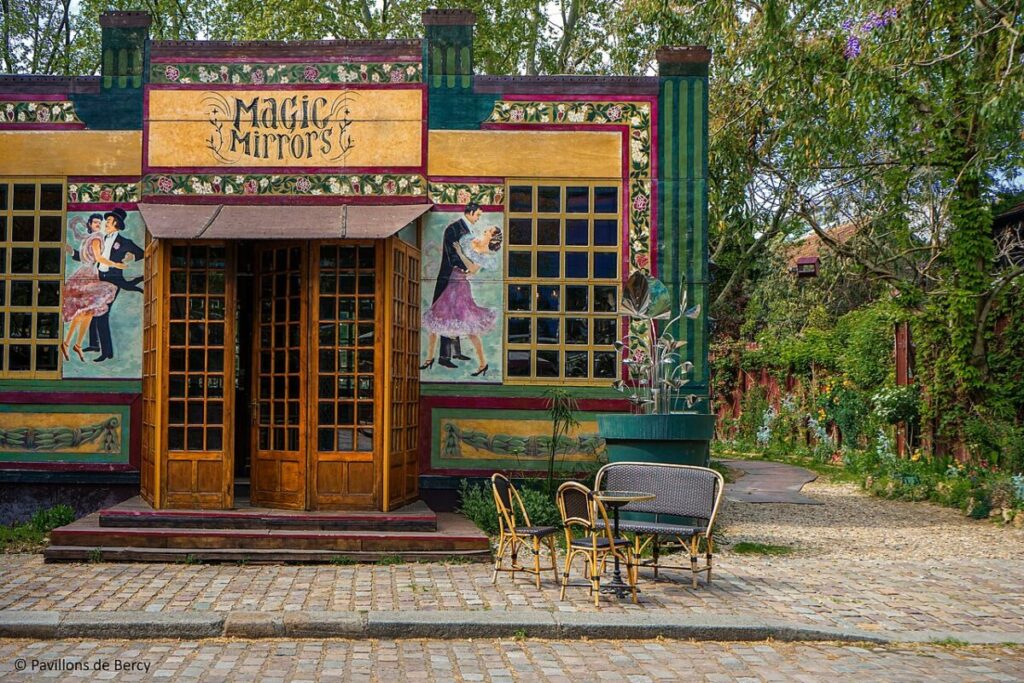
Outside, the Magic Garden provides a transition between the different warehouses. It is an enchanted green space where 18th-century statues stand near trees decorated with hanging crystal chandeliers.
This outdoor area preserves the industrial feel of the old wine market while adding a layer of whimsical design.
Interactive Rides and Games
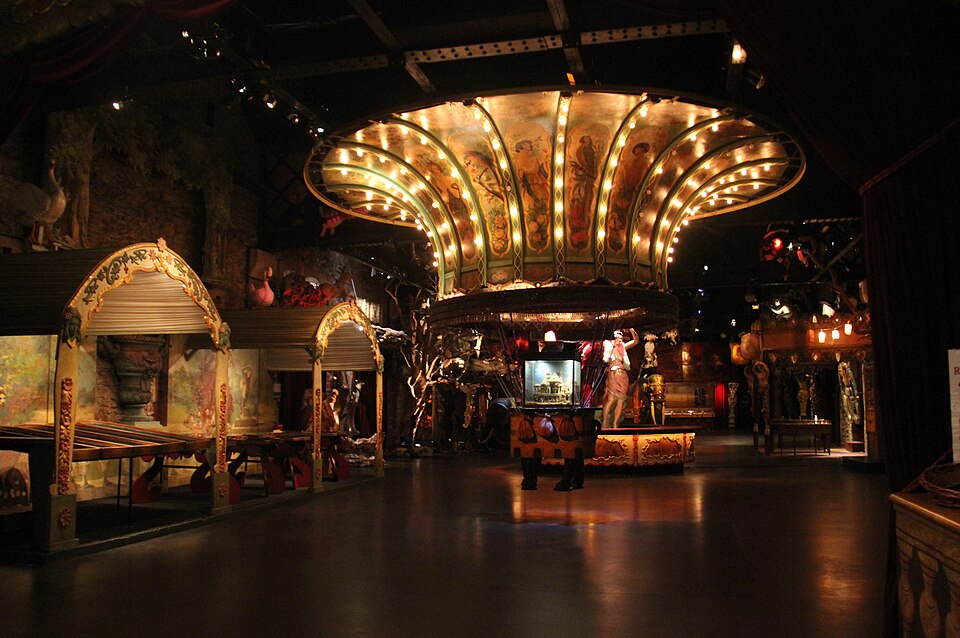
The main draw for most visitors is the opportunity to operate the historic machinery. The most famous attraction is the Velocipede Carousel, built in 1897. It is one of only a few operational models left in the world.
This ride does not use a motor, instead, the passengers must pedal bicycles to make the entire structure rotate. As the riders pedal harder, the carousel gains momentum, eventually reaching a top speed of 40 km/h. It was originally created to help the public get comfortable with the then-new invention of the bicycle.
Competitive play is also a major part of the experience. Visitors can participate in the Garçons de Café, or Waiters’ Race, which is a classic mechanical arcade game. Players toss balls into specific targets to move their miniature waiter figurine across a track.
These games were the precursors to modern midway attractions and show the mechanical ingenuity of the late 1800s.
Because the equipment is antique and valuable, these activities are always supervised by guides who ensure the machinery is handled correctly while still allowing everyone to participate.
Planning Your Visit
Accessing the Musée des Arts Forains requires more planning than a typical Parisian landmark because it is not open for walk-in visitors. You must book a guided tour in advance through their official website.
These tours usually last 90 minutes and are led by guides who are often professional actors. While the standard tours are conducted in French, the museum provides detailed English-language handouts that cover the historical context of each room.
During the peak summer season and school holidays, the museum frequently adds specific English-language time slots to its calendar.
The museum is located at 53 avenue des Terroirs de France, easily reached by taking Metro Line 14 to the Cour Saint-Émilion station. This puts you right in Bercy Village, a shopping and dining complex built into old wine storage cells.
The museum is fully accessible for those with reduced mobility, with all the rooms on the ground level. Note that the private street between the buildings is made of historic cobblestones, which can be uneven for wheelchairs or strollers.
Special Opening Times
While guided tours are the norm, there are 2 times a year when the museum changes its format. During the Festival du Merveilleux in late December and the European Heritage Days in September, the museum opens for self-guided exploration.
During these festivals, no reservations are required, and the space is filled with live performers including acrobats, musicians, and magicians who put on short shows every 5 to 10 minutes. This is the best time to see the collection if you prefer to wander at your own pace.
Tickets for adults are 18 €, while children aged 4 to 11 pay 12 €. Children under the age of 4 enter for free.
This museum remains a hidden gem for those looking to see a side of Paris that is both historically significant and genuinely fun.