
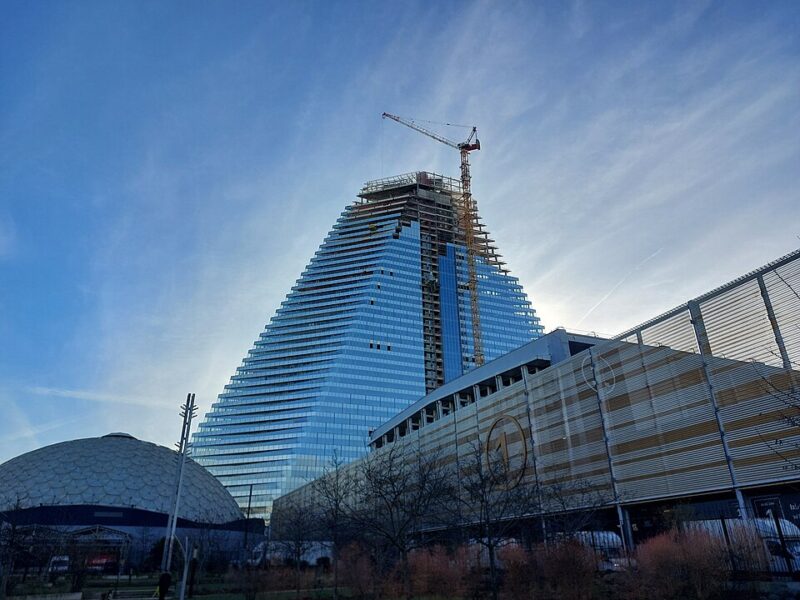
Paris Is Getting Its First Skyscraper in 53 Years
Paris has spent the last half-century saying no to skyscrapers.
After Tour Montparnasse went up in 1973 – and became one of the most hated buildings in France almost immediately – the city essentially slammed the door on tall buildings.
A height limit of 37 meters went into effect in 1977, and it held for over 30 years.
So what does it take to build a skyscraper in Paris in 2026?
Apparently, about 20 years of fighting.
The Tower That Refused to Die
The Tour Triangle was first proposed back in 2006 by Swiss architecture firm Herzog & de Meuron.
It immediately ran into opposition. Neighborhood groups sued. City councils voted it down. Politicians argued.
The project got rejected, revived, challenged in court, and delayed so many times that most people assumed it would never happen.
Construction finally started in 2022.
This May, the 180-meter tower reached its full height in Paris’s 15th arrondissement – a milestone called “topping out.”
The silhouette is now visible above the rooftops of southwest Paris for the first time.
Not Tour Montparnasse
Tour Montparnasse is a slab of dark glass from the early 1970s. Parisians joke that the best view in the city is from its observation deck – because it’s the only place from which you can’t see it.
Tour Triangle was designed with that reputation very much in mind.
From central Paris, the building looks like a slim, almost delicate glass tower. From the east or west, you see the full width – a massive triangle.
The glass facade shifts with the light throughout the day, sometimes practically disappearing against the sky.
It’s 42 stories tall. That’s smaller than it sounds in the context of American skyscrapers, but in Paris, where most of the city is capped at 5-7 stories, it’s a genuine landmark.
It’s Not Just an Office Building
Yes, there are offices, around 70,000 square meters of them, enough for roughly 5,000 workers. But that’s only part of the building.
The tower will also include:
- A Radisson Blu hotel with 128 rooms
- A panoramic restaurant at the top with views across the city
- A cultural center open to the public
- A medical center and health facilities
- A childcare center
- 750 square meters of retail at street level
- Two outdoor terraces totaling 2,600 square meters
The panoramic restaurant alone will make this a destination for visitors. It’s similar in concept to the restaurant at the top of the Centre Pompidou, except 180 meters up instead of 40.
The Green Numbers
One of the arguments used to finally get this tower approved was sustainability.
Tour Triangle is designed to produce only about 25% of the CO₂ that a conventional building of its size would emit. The large glass panels are positioned to maximize natural light, cutting down on artificial lighting.
The building is on track to receive both HQE and BREEAM environmental certifications – two of the most rigorous green building standards in Europe.
For a city that takes its environmental image seriously, those numbers mattered politically.
The Irony of Getting Built
Tour Triangle opens a complicated question: does this change what Paris looks like, or is it a one-time exception?
The answer is probably both.
The controversy over this project was so intense that Mayor Hidalgo used it as a reason to reinstate strict height limits. The new rules cap office towers at 180 meters and housing at 50 meters. Tour Triangle hits exactly the office ceiling.
That means Tour Triangle may be the first new skyscraper in Paris in 53 years – and also, for a very long time, the last.
The tower is expected to open to the public later in 2026. The panoramic restaurant at the summit will be open to all visitors, not just hotel guests or office workers.
Herzog & de Meuron put it simply when the topping-out was announced: “Triangle will be a destination for everyone.”