
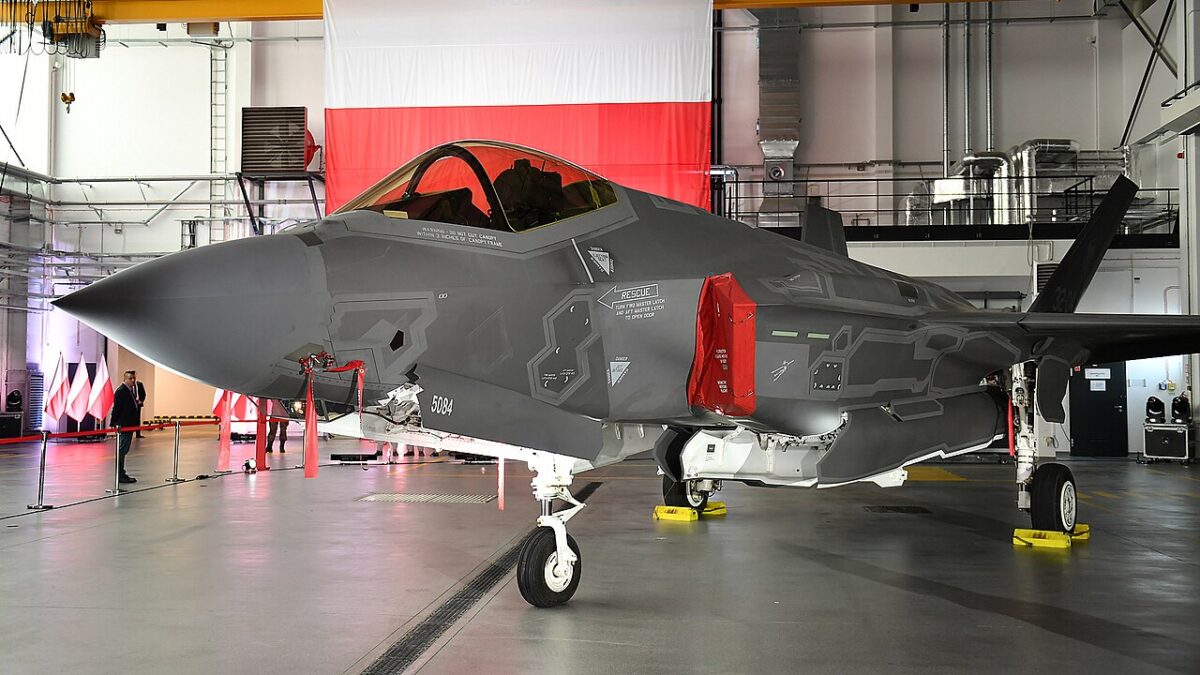
Poland Becomes the First Country on NATO’s Eastern Flank to Fly the F-35
The jets that Poland has been waiting six years for have finally arrived.
On May 20, 2026, the first Lockheed Martin F-35A Husarz fighters touched down at the 32nd Tactical Air Base in Lask.
Poland is now the first nation on NATO’s entire eastern flank to operate a fifth-generation combat aircraft. That’s a real geopolitical shift.
Not long ago, Polish pilots were flying Soviet-built MiG-29s and Su-22 fighter-bombers – aircraft delivered from the USSR back in the 1980s.
Poland even donated part of its MiG-29 fleet to Ukraine after the war began.
The transition to the F-35 is about as dramatic a reversal as you can get in military aviation.
These are not upgraded Cold War planes. The F-35A is a fifth-generation stealth fighter, purpose-built for the kind of high-intensity warfare that Europe now has to think about.
Poland calls its version the Husarz – a nod to the legendary Polish winged cavalry that once terrified Ottoman armies across Eastern Europe.
$4.6 billion bet on America
Poland signed the purchase agreement in 2020: 32 F-35A jets from Lockheed Martin for $4.6 billion.
Training started in 2024 at Ebbing Air National Guard Base in Fort Smith, Arkansas. Polish pilots have already surpassed 1,000 flight hours in the aircraft. The contract includes training for 24 pilots and 90 ground crew members.
Getting qualified on an F-35 is not cheap. Col. Krzysztof Duda, commander of the 32nd Tactical Air Base in Lask, estimates the cost at around $55 million per pilot.
Read that again. Fifty-five million dollars. Per person.
The base has been waiting
Fox News Digital got exclusive access to Lask last week, where empty hangars were already being prepped for the jets’ arrival.
New operational infrastructure, maintenance systems, and classified facilities built to American certification standards are all in place.
The base will house the first F-35 squadron. A second squadron is planned for the 21st Tactical Air Base in Swidwin. Full delivery of all 32 jets runs through 2030.
Americans and Poles, side by side
What struck visitors to Lask was not just the hardware. It was the people.
American and Polish personnel train, operate, and in some cases live together on the base.
Lt. Col. Pete Nanoslawski, a New Yorker who has been stationed in Poland for five years, described Poland’s appetite for American military systems as “insatiable – and rightfully so.”
Col. Duda, who studied at the U.S. Air War College, put it bluntly: “The marriage we have with the U.S. on the military level, even if you want to divorce, we would not.”
NATO burden-sharing is under political scrutiny in Washington, and the Pentagon recently canceled a planned U.S. armored brigade rotation to Poland – a decision Warsaw is still seeking answers about.
How the F-35 will be used
Poland’s F-35s will not replace its F-16s. They will work alongside them.
Poland fields 48 F-16C/D Block 52+ fighters. In 2025, Warsaw signed a $3.8 billion deal to upgrade the entire F-16 fleet to the F-16V Block 72 standard, adding AESA radars and full integration with the F-35 system.
The two-tier approach: F-35s handle stealth penetration and battlefield data collection, while the modernized F-16s carry the main strike load.
NATO planners consider this combination one of the most effective force structures in modern air warfare.
On top of all this, Poland has ordered 96 AH-64E Apache attack helicopters – one of the largest Apache orders anywhere in the world.
Impact for U.S. Travelers in Poland
If you are planning a trip to Poland or Central Europe, you will notice the difference on the ground. The country feels different from even five years ago.
Defense spending has transformed cities near air bases. Lask, Swidwin, and other military towns have seen infrastructure investment that spills into the civilian economy.
American contractors, trainers, and military families are part of the local scene in ways they simply were not before.
And the mood among Poles toward Americans is warm in a way that is specific and personal.
They are neighbors who remember what Soviet-era air power actually felt like – and they are not going back.