
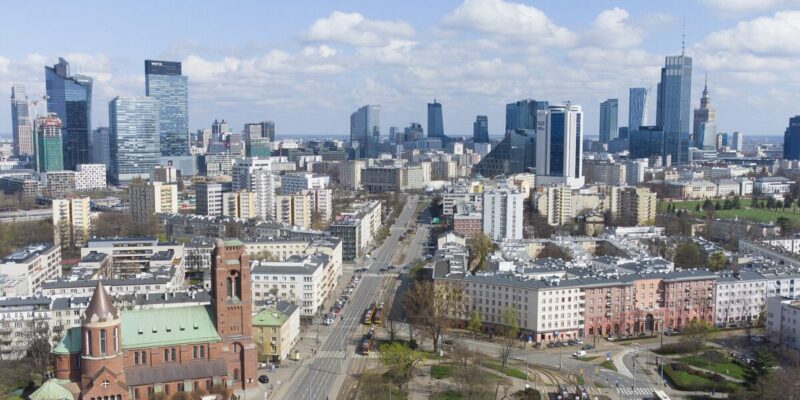
How Poland Went From Europe’s Underdog To Its Trillion-Dollar Success Story
Poland joined the European Union on May 1, 2004. At the time, the country had a 19% unemployment rate and a GDP per capita sitting at just 51% of the EU average.
Twenty-two years later, Poland is an entirely different country.
Poland’s economy has roughly quadrupled in size since joining the EU. Its nominal GDP recently crossed the $1 trillion mark, making it the 20th largest economy in the world.
To put that in perspective, economists at the Polish Economic Institute calculated that Poland’s GDP per capita would be stuck at 2014-2015 levels if the country had never joined the EU.
Instead, GDP per capita has gone from 51% of the EU average all the way up to 81% in 2025.
That’s the closest Poland has ever been to Western European living standards.
Unemployment Went Off A Cliff
When Poland joined the EU in 2004, nearly one in five working-age Poles was unemployed. The rate was around 19-20%, one of the worst in Europe.
Today it sits below 3%, one of the lowest in the entire EU. Wages have increased by 267% over that same period, and the minimum wage has gone up by over 400%.
The opening of European labor markets was a huge part of this. Millions of Poles gained the right to work anywhere in the EU, and the flood of foreign investment that came with membership created jobs at home too.
Where Did The Money Come From?
Between 2004 and 2024, Poland received a net total of about 160 billion euros in EU funds. That money went directly into roads, railways, airports, schools, hospitals, and energy infrastructure.
The highway network alone grew by 225%. If you drove across Poland 20 years ago and you drive across it today, you’d think you were in a different country.
But the EU funds were only part of the story. The real engine was the single market. Foreign direct investment increased 21-fold. Polish exports to other EU countries grew sixfold. Agricultural exports grew elevenfold.
Poland Is Spending More On Defense Than America
Here’s the part most Americans don’t know.
Poland currently spends about 4.5% of its GDP on defense – more than any other NATO country, including the United States (3.2%). It has the sixth-largest defense budget in the entire alliance at around $44 billion.
A huge chunk of that spending goes directly to American defense companies. Poland has been buying American tanks, fighter jets, rocket launchers, and air defense systems at a pace that few other allies can match.
The country that joined the EU as one of its poorest members is now the one most aggressively arming itself against Russia – right on NATO’s eastern border.
The Flip Side
Not everything is perfect. Poland still lags behind Western Europe in research spending, healthcare investment, and innovation.
The country faces a serious demographic challenge, with a declining birth rate that could slow growth in the coming decades.
And there are political tensions too. Poland’s relationship with EU institutions has been rocky at times, with disputes over judicial independence and rule of law that made headlines for years.
But economically? The transformation is the most dramatic in modern European history.
What It Means For Travelers
If you’ve been to Poland recently, you already know this. Warsaw, Krakow, and Gdansk have become some of the most popular travel destinations in Europe, and for good reason.
The infrastructure is modern, the food scene is booming, and your dollar goes further than it does in Paris or Rome. Poland welcomed over 80 million foreign visitors in a recent year.
Twenty-two years ago, 77% of Poles voted to join the EU. Today, about 80% say membership has been good for the country. The numbers back them up.