
L’Instrument des Immortels: The Piano the U.S. Army Sent to War
When the United States entered WWII, morale became a serious concern. Troops were being moved through unfamiliar countries for months at a time, often with nothing to break the routine of marching, digging, waiting, and fighting.
Radios helped, books helped, but commanders wanted something that worked anywhere and gathered men together quickly.
Made for the Front
In 1942, the War Production Board asked Steinway to design a field-ready piano.
Metal was rationed, transport was limited, and the instrument had to survive humidity, shocks, salt air, and rough storage.
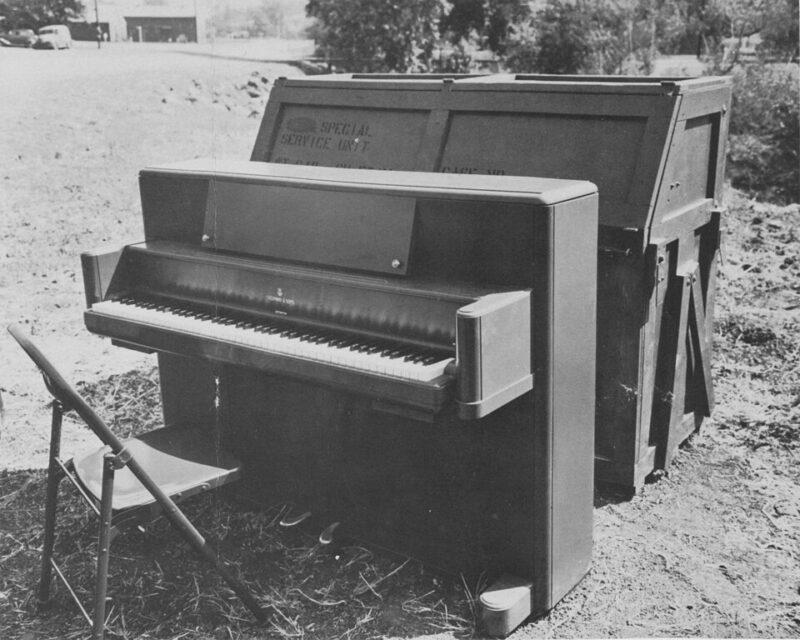
Steinway responded with the Victory Vertical, a compact 40-inch upright weighing about 200 kg. It used minimal metal, iron-wound strings instead of copper, and celluloid keys in place of ivory.
The case was reinforced and finished in olive drab or blue-grey to match Army equipment.
Each piano shipped with tuning tools, spare parts, and a tailored packet of sheet music: hymns, marches, boogie-woogie, popular American songs, and simplified classical pieces.
The goal was simple: a trained pianist could play almost anything on it, and a homesick corporal could still manage a tune that lifted the camp’s mood.
Music in War Camps
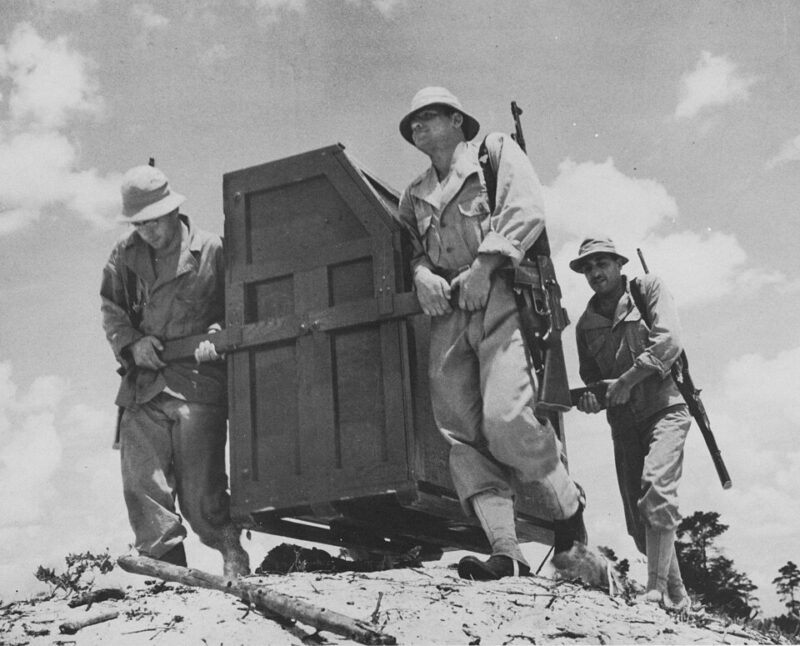
The Victory Vertical was airdropped by B-17s onto battlefields in every major theater: North Africa, Sicily, Italy, England, France, the Ardennes, and occupation zones in Germany.
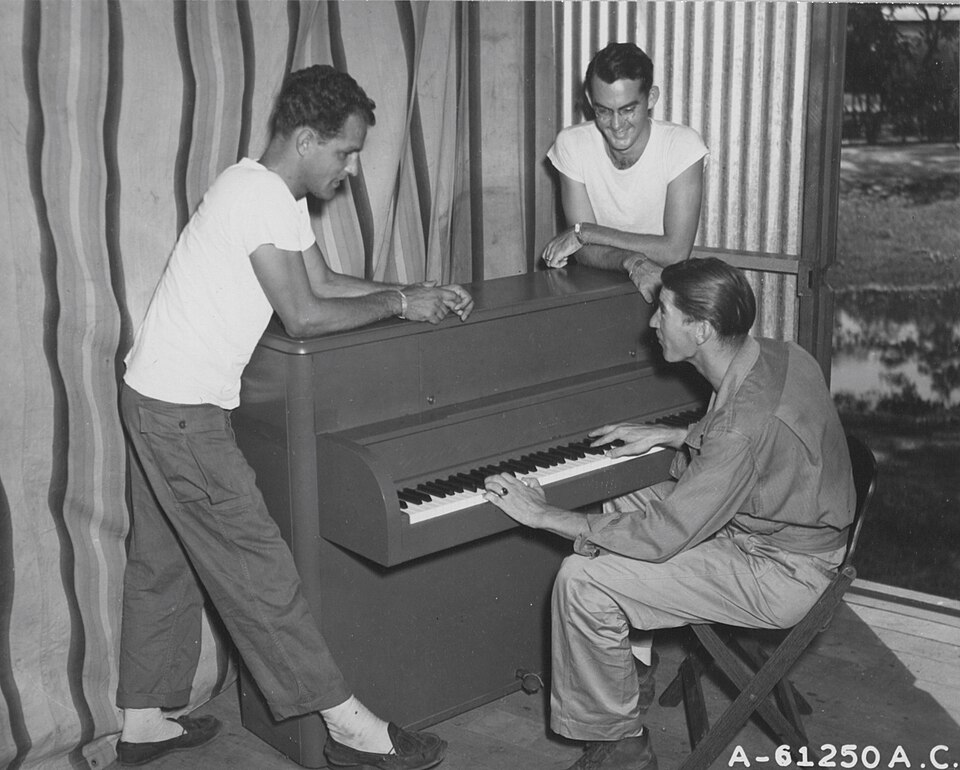
Soldiers unpacked them in barns, hospitals, tents, ruined schools, and outdoor chapels. They were dragged by jeeps, carried by stretchers, and sometimes lowered from planes in crates.
Letters from GIs describe the effect. One wrote about a muddy evening in Italy when a jeep hauled a khaki piano into camp and the entire unit gathered around it within minutes.
Another, recovering in a field hospital, explained how hearing a familiar hymn helped him “feel like a person again for the first time in weeks.”
These scenes pushed the Army to order more, eventually reaching roughly 2,436 units.
The Slogan That Led to the Nickname
“L’instrument des immortels” did not actually originate in wartime camps. Steinway created the slogan in the 1920s–30s to promote its concert grands.
French newspapers printed the translated line in ads that linked Steinway with virtuosos like Rachmaninov and Paderewski. The phrase stuck to the brand long before the first Victory Vertical left New York.
Decades later, when French journalists revisited the story of the G.I. pianos, they reused the old slogan.
The contrast between Steinway’s prestige image and these battered, olive-drab uprights made the association irresistible. The result was a poetic nickname applied retroactively.
The French Survivors
Very few Victory Verticals remain in France today. One of the most documented surfaced in 2023 thanks to a simple Leboncoin listing.
Piano technician Théo Taillasson of Rochefort had been searching for one. A seller in Rome contacted him with a 1945 unit, serial number 317874, originally issued to U.S. forces in Italy.
Taillasson bought it for 2,500 euros and brought it back to France. The piano showed signs of hard service: layers of paint, dents, worn felts, and military hardware identical to wartime photographs.
During restoration, he returned it to its original olive-drab finish, replaced parts using period-correct materials, and kept the transport scars visible.
Today, that piano appears in exhibitions and concerts. Visitors can see the reinforced frame, the compact action built for quick transport, and the faint stenciling still visible on the back.
Other known examples in France include one at the Mémorial de Caen, two restored by Ateliers Hanlet, one in Bourges, and at least one in private hands.
Survivors often still carry shipment markings linking them to ports like Naples, Oran, or Southampton.
What Happened After the War
Once the war ended, the Victory Verticals didn’t follow the strict recovery process used for military vehicles. Many were left in European camps, schools, or town halls and later used for local events until they wore out.
Others returned to U.S. bases for chapels and recreation rooms. A few were taken home informally by soldiers with access to transport crates, which explains why some American survivors still show traces of olive-drab paint beneath later refinishes.
The rarest finds are the ones with original sheet-music packets still tucked inside the fallboard. French restorers have reported sets containing “You Are My Sunshine,” “Deep in the Heart of Texas,” “Beer Barrel Polka,” “Clair de Lune,” and a small selection of hymns.
Some even contain pencil notes left by GIs stationed in Italy or eastern France.