
Your New French Best Friend is a $129 Plastic Necklace
The streets of Paris and New York are currently covered in minimalist white posters making a very strange promise. One sign says it will never leave dishes in the sink. Another claims it is always down for a coffee at a moment’s notice.
These ads are not for a new dating app or a roommate matching service. They are for Friend, an artificial intelligence wearable designed to listen to every word you say and text you back like a supportive companion.
Created by 23-year-old developer Avi Schiffmann, the device has sparked a huge debate about whether we are solving loneliness or simply automating it.
The Physical Device
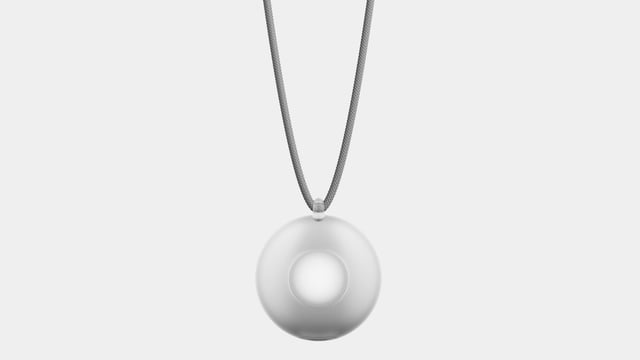
The Friend necklace is a small white circular pendant that hangs around your neck. It does not have a screen and it does not use a speaker to talk to you. Instead, it functions entirely through your smartphone.
The hardware is equipped with a high-fidelity microphone that stays on at all times. It connects to your phone via Bluetooth and uses advanced language models like Claude 3.5 to process what it hears.
When the device detects something interesting in your environment or conversation, it sends a notification to your phone. It might comment on a joke you just heard or offer encouragement before a stressful meeting.
The device costs $129 and doesn’t require a monthly subscription. Schiffmann spent $1.8 M just to buy the domain name for the product, signaling his belief that this is the future of human interaction.
The necklace is designed to be a passive observer of your life. It is not meant to be a productivity tool like a digital assistant that sets timers or adds items to a grocery list.
Its sole purpose is to be a digital companion that knows your history, your quirks, and your daily routine.
The Marketing Blitz
The advertising campaign in the Paris Metro has been intentionally provocative. By placing ads in high-traffic hubs like Châtelet–Les Halles and Montparnasse–Bienvenüe, the company is targeting the very places where urban loneliness feels most acute.
The slogans are written in French and focus on the reliability of the AI compared to the flakey nature of human friends.
This strategy has led to significant backlash from commuters. Many Parisians have labeled the campaign dystopian, with some even comparing it to a real-life episode of the dark tech-satire show Black Mirror.
The pushback has not discouraged the company. In fact, Schiffmann has embraced the controversy. After his $1 M campaign in New York City resulted in dozens of vandalized posters, he suggested that the anger was part of the intended experience.
He views the marketing as a form of performance art that forces people to confront how they feel about the blurring lines between technology and intimacy.
In Paris, the ads continue to be a lightning rod for graffiti, with locals often writing messages over the posters that urge people to put down their phones and talk to real neighbors instead.
Privacy and Safety
Because the Friend necklace is always listening, it has raised massive red flags for privacy advocates. The company insists that the device is secure. They claim that data is end-to-end encrypted and that raw audio files are never permanently stored on their servers.
Instead, the audio is processed in a short window of time to create a transcript, which the AI then uses to form a response.
The company also states that there is no cloud backup for these memories. If you lose the physical necklace, the history of your relationship with that specific AI is gone forever.
Despite these assurances, the legal landscape in Europe is complicated. France has strict data protection laws under GDPR that require consent from anyone being recorded.
Since the necklace picks up the voices of everyone in a room, it technically captures data from bystanders who never agreed to be part of an AI experiment.
There are also concerns about prompt injection, where a stranger could speak a specific command near your necklace to manipulate the AI’s behavior.
The long-term impact of having a third-party company essentially “witness” every private moment of a user’s life remains a major point of contention.
A Social Experiment
The Friend necklace represents a shift in how we think about artificial intelligence. While companies like Google and Microsoft focus on making AI a better worker, Friend is trying to make AI a better pal.
Critics argue that this is a dangerous band-aid for the global loneliness epidemic. They suggest that a device that always agrees with you and never has its own needs is not a friend, but a mirror.
However, supporters of the tech argue that for people who are truly isolated, a non-judgmental digital presence can provide genuine emotional support and a feeling of being seen.
The campaign that continues to roll through the Paris Metro also serves as a large social experiment. It asks whether we are ready to accept a world where our closest confidant is a piece of plastic powered by a server farm.
Whether the device becomes a big hit or a cautionary tale, it has already succeeded in making the world stop and argue about what it means to be a friend in 2026.